
Trillium’s Project Falcon: the world’s first demo plant for 100% biobased acrylonitrile

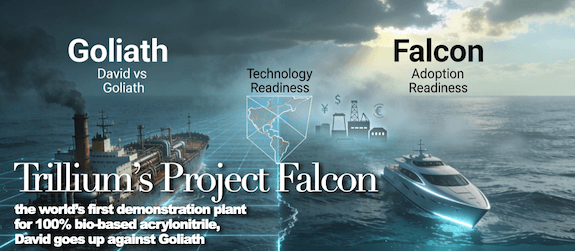
Somewhere between a successful pilot and a financeable commercial plant lies the most dangerous territory in industrial innovation. It’s not failure that kills promising technologies—it’s success without a system ready to absorb it. The chemistry works. The data holds. And still, the project stalls, stranded between proof and scale.
This week, Trillium Renewable Chemicals stepped directly into that gap.
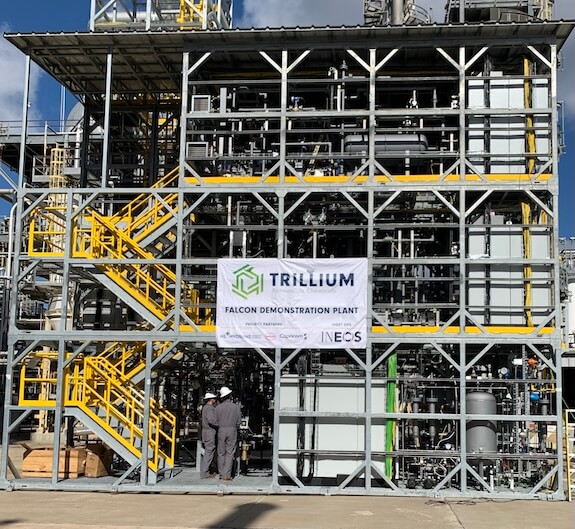
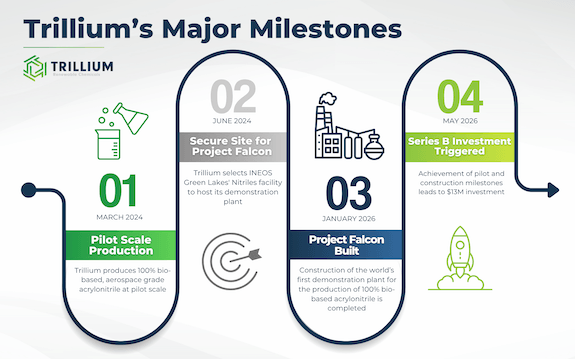
With $13 million in new Series B financing, the company is launching Project Falcon, the world’s first demonstration plant for 100% bio-based acrylonitrile, slated for commissioning in 2026 at INEOS Nitriles’ Green Lake facility in Texas. It’s a milestone not just for Trillium, but for a sector that has spent decades trying to push sustainable chemistry out of the lab and into the real economy.
On paper, Falcon looks like a breakthrough. In practice, it is something more difficult: a crossing between two fundamentally different maps.
Trillium has already conquered the first map—the familiar terrain of Technology Readiness Levels. The chemistry works. The process converts glycerol into acrylonitrile at pilot scale. The yields are understood, the system behaves. In TRL terms, the path is visible.
But Falcon is not a pilot. It is a First-of-a-Kind (FOAK) demonstration facility—the exact point where public R&D support begins to fall away and private capital starts to hesitate. This is the “valley of death,” where technologies that function in the lab must prove they can survive in the market.
And that market runs on a different map entirely.
Call it Adoption Readiness. Not whether the molecule works—but whether the system will take it.
Because acrylonitrile is no niche target. It is an invisible giant—more than 6 million metric tons produced annually, feeding carbon fiber, ABS plastics, synthetic rubber, and performance textiles. It is embedded in global supply chains, optimized over decades, financed by institutions that understand its risks, and priced by markets that reward its predictability.
This is where most green chemistry companies falter. Not because their technology fails, but because the system around them doesn’t move. Switching costs accumulate—reformulation, testing, certification, supply chain adjustments—until even superior products struggle to gain traction.
Trillium’s strategy is to remove the friction entirely.
Its process produces a true drop-in replacement: the exact same acrylonitrile molecule used today, derived from plant-based glycerol. No downstream changes. No requalification. No disruption to existing manufacturing systems.
Most sustainable technologies ask the world to adapt. Trillium is asking nothing at all. That is more than a technical advantage. It is a change in the conditions of adoption.
In yesterday’s Digest, we explored the idea that David didn’t defeat Goliath by strength—he won by changing the physics of the encounter. Trillium is attempting something similar here. By eliminating switching costs, it has removed one of the system’s primary defenses against change.
If that holds, Falcon is not just a demonstration plant. It is proof that zero-friction chemistry is possible. But even that may not be enough. Because markets do not scale what they admire.
A demonstration plant can be funded on promise. A commercial facility—hundreds of millions in capital—requires predictable revenue, long-term offtake agreements, and confidence that demand will exist at scale. Even a perfect drop-in molecule must compete with fossil incumbents that benefit from decades of optimization, embedded infrastructure, and cost advantages that are not easily displaced.
Trillium has already navigated the early phase of this journey with unusual precision. It leveraged a $2.5 million U.S. Department of Energy award to validate its pilot program and is now co-locating Falcon within an existing INEOS Nitriles facility—borrowing infrastructure instead of building it from scratch. Its investors include HS Hyosung Advanced Materials, a major downstream player, aligning supply with future demand.
This is not a company operating in isolation. It is embedding itself within the very system it aims to transform—executing, in real time, the kind of cross-value-chain collaboration that many policy frameworks only theorize.
And yet, the final barrier remains.
Without durable demand signals, even the most elegant technologies can stall. The industry has seen how this story can end—Danimer Scientific demonstrated that production capacity can be built ahead of stable demand, and the result was financial collapse when that demand failed to materialize.
This is where policy stops being support and becomes structure. The Change Chemistry framework points to mechanisms that do not just encourage markets but create them. Advance market commitments—famously used in Operation Warp Speed—guarantee future demand, allowing capital to flow ahead of adoption. Carbon Contracts for Difference, now deployed in Europe, bridge the cost gap between low-carbon and conventional production, stabilizing revenue for early movers.
These are not marginal tools. They are adoption infrastructure. They turn uncertain markets into bankable ones. They allow financiers to underwrite not just technology risk, but demand risk. And in doing so, they convert promising FOAK facilities into scalable commercial systems.
So where does that leave Project Falcon?
Exceptionally well-positioned—and still exposed. Trillium has done something rare. It has not just built a better molecule; it has removed one of the system’s core resistance mechanisms. It has crossed the TRL map and is now navigating the far less charted terrain of Adoption Readiness, armed with a strategy that minimizes friction and maximizes alignment.
It has, in effect, taken away Goliath’s advantage. But Goliath was never just a competitor. It was the system itself.
And systems do not change simply because a better option exists. They change when the conditions around them shift—when demand is secured, when financing aligns, when the map of adoption becomes as clear as the map of invention. Trillium has built a remarkable vessel. Falcon may prove it seaworthy. The question now is whether the market is ready to receive it—or whether the map itself must be redrawn.